
I left Muskego High School at one o’clock most afternoons, drove down the street to the district office, and worked until six. Then I drove to a computer shop and built PCs until ten. The district job was the real one. I was the web guy for the school system I was enrolled in.
Over the next eight years I designed and built the district’s first actual website, a publishing system that let every school run its own pages, and the identity for its cable television channel. Most of it went up over a cable modem in my parents’ house.
There was no website. There were pages.
The district already had things on the web when I arrived, going back to December 1998. A teacher had taken it on himself to try out the new web technology and had got further with it than anyone else in the building. He was also learning it as he went, and past a certain point it stopped holding together. I took it over not long after.
What I inherited was hundreds of pages made one at a time in FrontPage on separate afternoons. Class pages, reading lists, a science unit with an animated water cycle. None of them knew about each other. A parent looking for a lunch menu had to already know which page happened to have it.
That was the actual problem, and it wasn’t a design problem yet. It was an organization problem.
The question, in writing, in January 2002
We had a Web Development Committee, and I still have the agenda from the meeting where this got settled. Item two:
Discuss school links: Should each school have its own individual home page, or a pre-designed home page?
Web Development Committee agenda, January 29, 2002
Underneath it, three sites to review. One district in Alaska, noted approvingly as an example of a pre-designed home page plus an individual site. The state’s own school directory. And Milwaukee Public Schools, annotated in two words.
Bad Organization.
The entire review of milwaukee.k12.wi.us
Then: Make final decision on item 2. We chose the pre-designed page, and everything I built afterward was in service of that decision. I did not know at the time that this was called competitive analysis. I just knew I did not want to guess.
mySite
The decision only works if the schools can actually maintain their own pages, and FrontPage was not going to get them there. It cost money the district did not want to spend a license at a time, and more to the point it asked teachers to understand a document model they had no reason to care about. Most of them tried it once.
So I built the thing that let them skip it. This was 2002. WordPress did not exist yet. Neither did Facebook or MySpace. The idea that an ordinary person would maintain their own page on the internet was not yet an idea anyone had.
Here is how I described it at the time, in a FAQ I wrote for staff:
There is no software to download or install, and an entire site can be updated in minutes. There is no previous HTML experience necessary. Anyone can point, click, and update.
mySite staff FAQ, April 2002
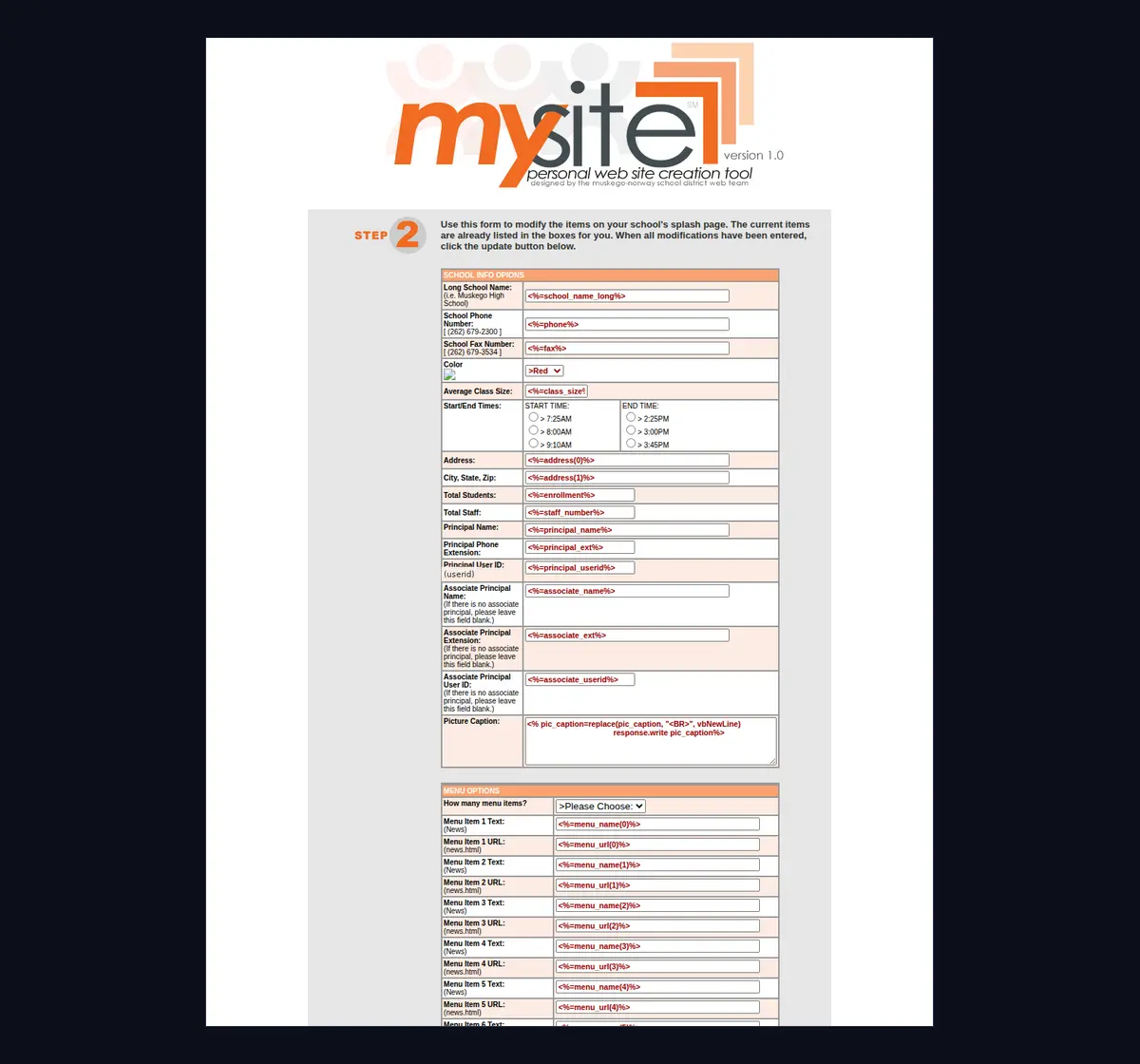
It was a form. A school secretary logged in and filled in the school’s name, its phone and fax, its start and end times, its address, its enrollment, its principal, and up to ten menu items for its own navigation. Every field was pre-filled with what was already there, and every field carried an example in parentheses so nobody had to wonder what shape the answer took.
Then it wrote the page back out and the school’s section of the site changed.
Building it was the easy half. Every month I ran a session for any teacher who wanted to come, and taught them how to use it and edit their own classroom page. That is where the design actually got tested. You find out very quickly which label is wrong when you are standing in a room watching eight people fail at the same field.
Asked how much it cost, I wrote: Nothing. Asked how long it took: approximately two weeks from start to finish. At the time I had no idea that was fast.
The snow day button
In Wisconsin, for about four months a year, the thing everyone wants from a school district website is whether there’s school tomorrow. So that got its own tool. One password, one dropdown with the three real answers already written, and a field for anything unusual. Three clicks and the whole district’s homepage changed.
The same button also pushed the announcement to Channel 13. Plenty of families in 2002 had no computer, and the TV was the only way to reach them. One button, both channels, so nobody found out late.
I was pressing it from my bedroom over a cable modem, as a student in the district it was closing.
What mySite turned into
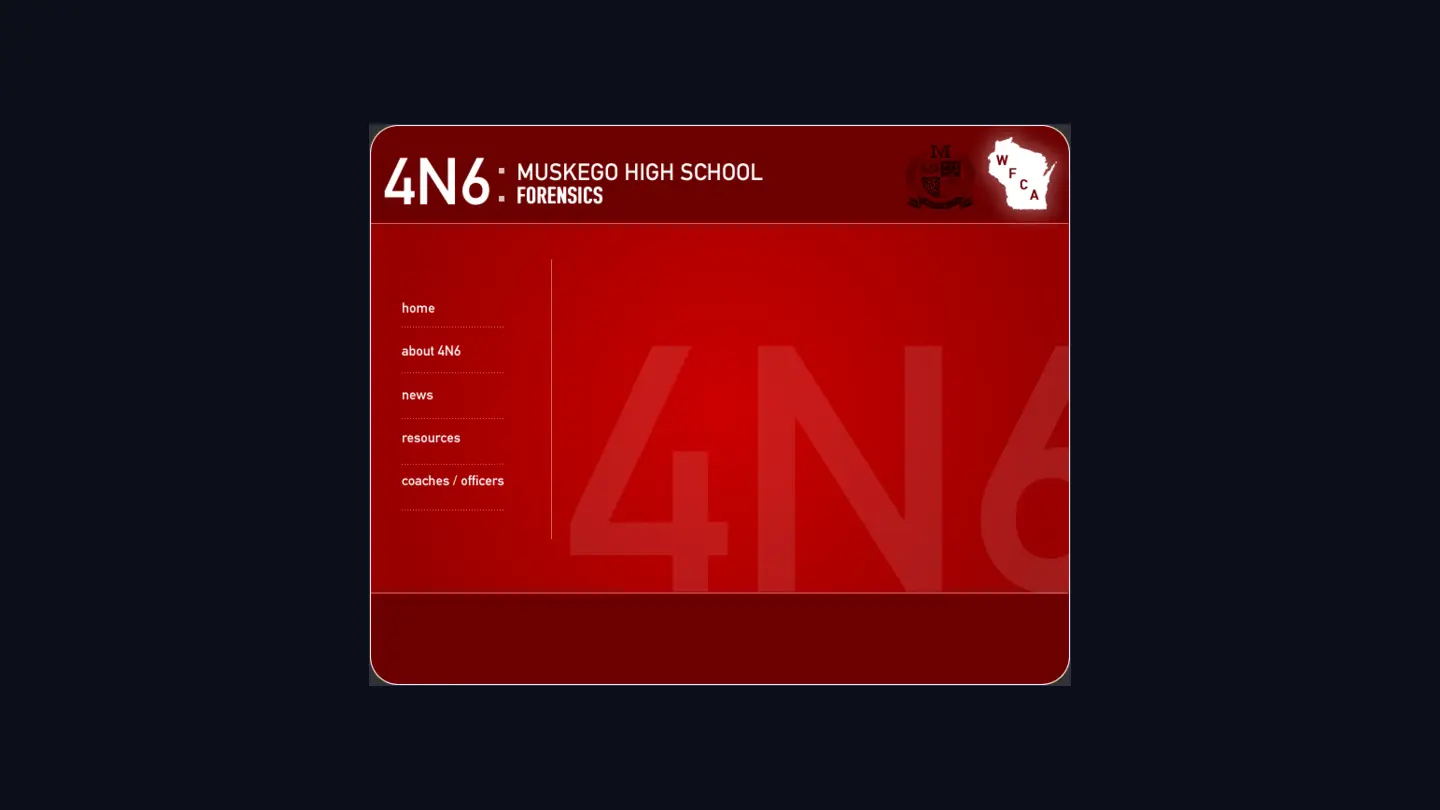
In December 2002 I built a site for the high school’s forensics team. Red, carrying the school crest and the state coaches’ association mark, with the team’s own navigation down the left. The high school I had graduated from two years earlier, for a team I was not on.
Then in late August 2004 I came back, and within three weeks mySite had a third version. It is written in ASP.NET rather than Classic ASP, it names itself in its own header as mySite: Core 3.0.1001, and it opens on a screen the first version never needed:
Choose a site below to begin your editing session.
mySite Core 3.0, September 9, 2004
One login, many sites, each listing when it was last updated. Version one let one school edit one page. Version three let one person manage a stack of sites, with a preview step before publishing and a newsletter editor next to it.
That is the version that outlived the school district. Through my freelance years the same bones were re-skinned client after client: a real estate agent who needed to manage her own listings, and a run of others after her who wanted to run their own sites without learning HTML or CSS. The problem never changed. Only the client did.
I’m still building the same thing. The system running a national wheel marketplace today came out of a form I wrote in two weeks for eight schools.
Channel 13
The district had a cable access channel, and between programs it ran a bulletin board: schedules, board meetings, announcements, weather. I designed it, and the content ran off a plain text file so the office could update it without opening Flash.
The detail I still think about is a change I made between the first and second versions. The schedule lines used dot leaders, the row of periods that carries your eye from a time across to a title. On a monitor they looked right. On an interlaced television they bloomed into a smear. So I retyped every one of them with spaces between the dots. That was the whole revision. Nothing else changed.
It is the first time I remember redesigning something because of the surface it would actually be read on, rather than the surface I made it on.
There is also a template in that folder dated September 11, 2001. It is the emergency override, and it still has that afternoon’s content in it: which activities were cancelled, which were not, and a line telling people to stay tuned. I had built an emergency state into the design because it seemed like something a school channel should have. That September I found out what it was for.

Asking the community for $36.6 million
In the fall of 2001 the district went to referendum. Muskego High School had been built in 1957 for 1,700 students, today’s standards put its real capacity at 1,250, and 1,491 were enrolled. The ask was thirty six and a half million dollars, and the vote was November 6.
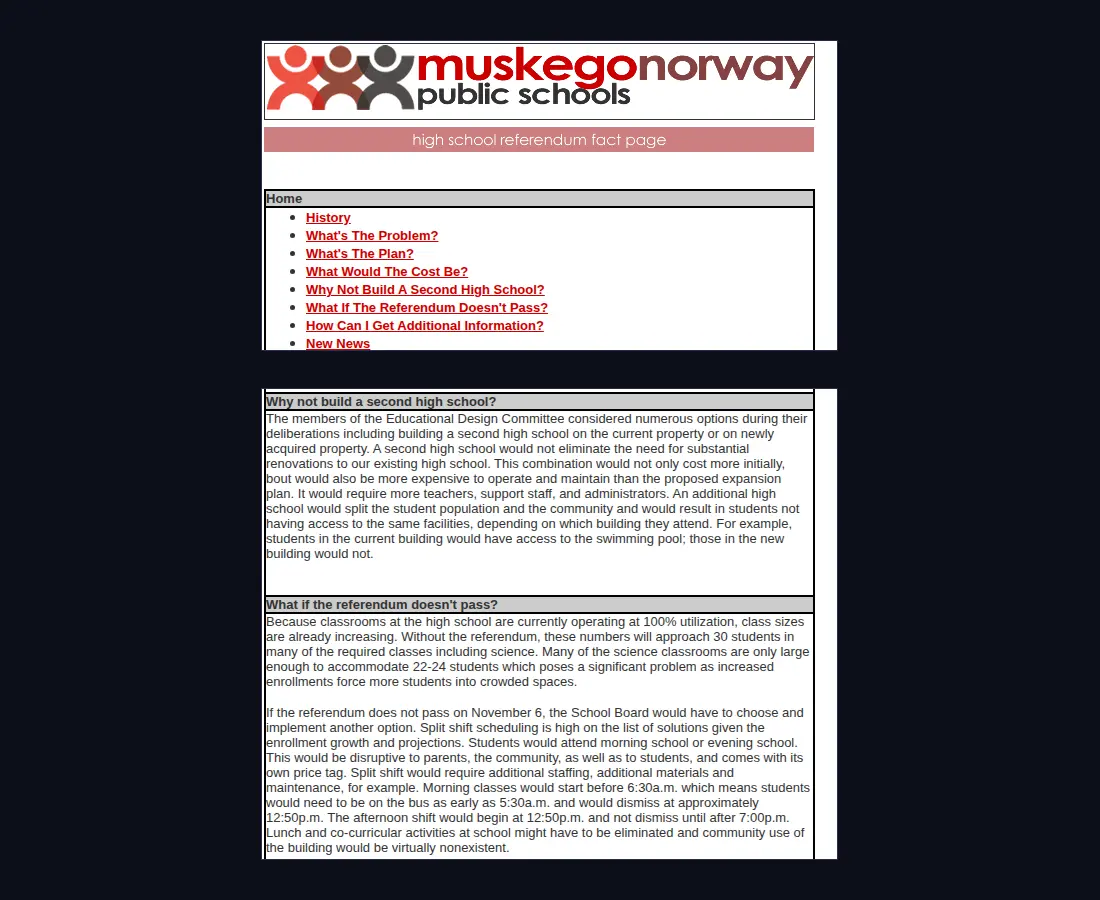
I built the page that made the case. It’s the only thing I made there that had to persuade rather than inform, and the part that still holds up is the order of the questions.
The navigation is seven questions. The first four are the easy ones: the history, the problem, the plan, the cost. The cost answer opens with Less than a dollar and then immediately does your arithmetic for you, ninety five cents per thousand of assessed value, twenty six cents a day on a hundred thousand dollar home, with both spending caps stated in full.
Then it puts the two hostile questions last and answers them properly. Why not build a second high school gets a real argument rather than a dismissal, down to the admission that a split campus would mean the kids in one building had the swimming pool and the kids in the other did not. What if the referendum doesn’t pass describes exactly what happens: class sizes near thirty, science rooms built for twenty two, and split shifts where some students board a bus at 5:30 in the morning and others are not dismissed until after seven at night.
Nobody told me to structure it that way. It just seemed obvious that the questions people were actually asking each other should be the questions on the page, in the order they would ask them, with the worst one answered rather than avoided.
Designing for what people actually had
In March 2002 the site checked whether you had the Flash plugin, and if you did not, it sent you to a page apologizing and explaining what you were missing. In April I changed it. Same detection, but now it served you the same page with a still image where the animation would have been, and never mentioned it.
One month between those two versions. The second one stops telling people their computer is wrong and just gives them what they came for.
The same instinct is all over that build. The browser compatibility page did not just refuse you, it listed the downloads, including Internet Explorer 5.1 for Macintosh, because some of the teachers were on Macs and nobody else had thought about them. The contact form resolved your zip code to your state entirely in the browser, using a hand packed lookup table, because on a dial-up connection a round trip to fill in one dropdown was a real cost.
What it turned into
The district’s own authoring log covers thirty three months. In that window, 83 staff accounts published 2,111 pages across 99 separate sites. Volume went up every year I could measure: roughly 3,800 publishing events in the back half of 2002, then 24,900 in 2003, then 35,300 in 2004.
I was not doing that work. That was teachers and secretaries and coaches updating their own pages, which was the entire point of building it.
Coming back
I left in 2002 and moved to Florida. When I moved home in late 2004 I walked into the district office and applied, and they hired me that day, mostly on the strength of what I had already built there. This time as a computer tech at the high school I had graduated from four years earlier. I picked the website back up as well.
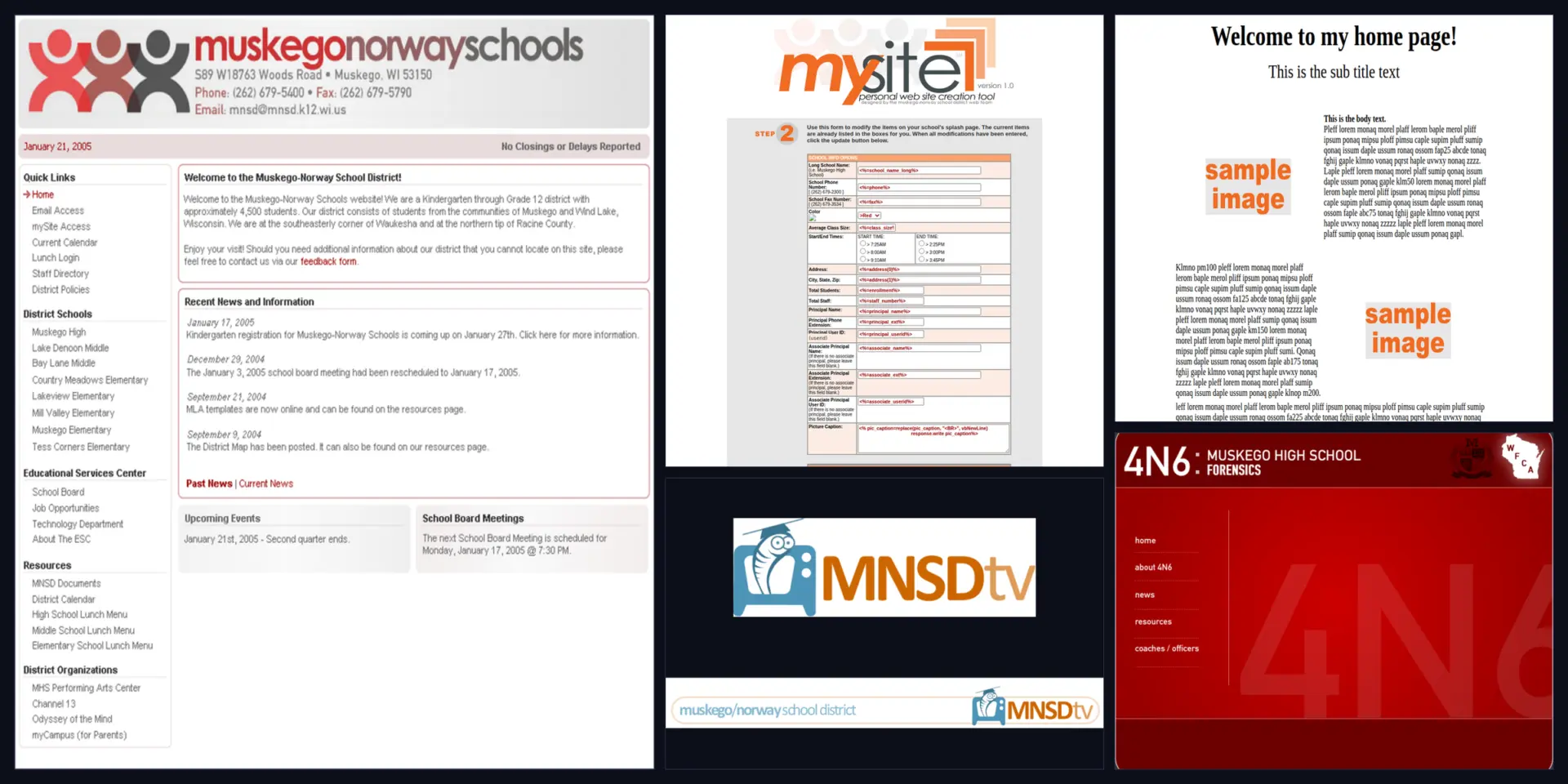
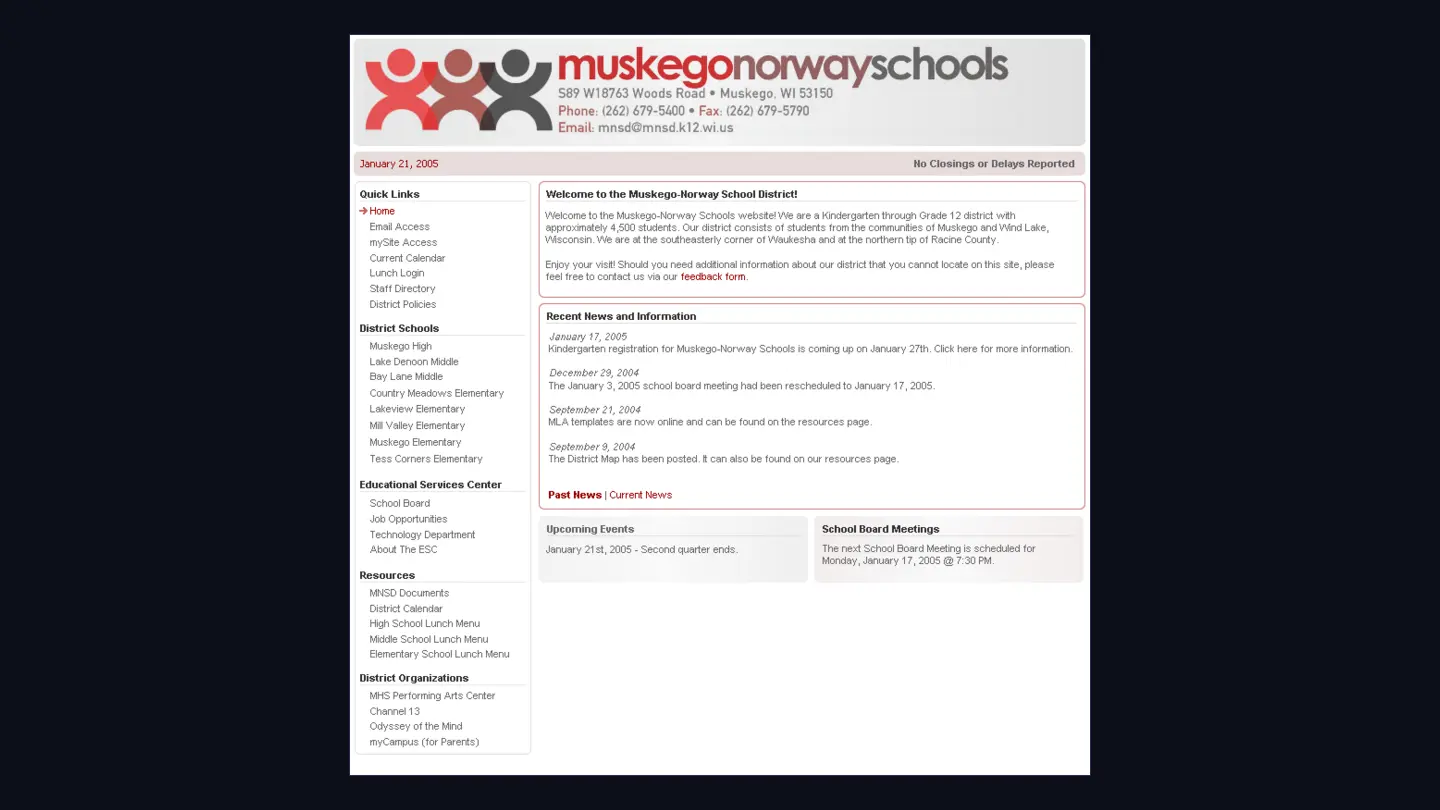
I redesigned the homepage in January 2005. It has the closings banner in the masthead, a quick links column that opens with email access and the lunch menu, and the eight schools listed by name. In 2006 I rebranded the television channel as MNSDtv, drew a new mark for it, and rebuilt the on-air frame.
Then I was done, and it kept running.
What I would tell you about it now
This was my first real job and I had no process, no vocabulary, and nobody to learn it from. Arguing in a committee meeting about whether each school should get its own home page was information architecture. Retyping dot leaders for a CRT was designing for context. A room of teachers getting stuck on the same field, once a month, was usability testing. I didn’t know any of those names at the time.
I just wanted it to work for the people using it, and I saw most of them in the hallway.
That’s still how I work. I picked up the vocabulary later.